Showing posts with label design. Show all posts
11/15/2011
Parameter
I've been told that my posts are 'shop-talk' heavy. This post probably won't differ in that regard, but it'll have way more explanations and illustrations--starting with the results of an experiment in parametric design I conducted in my third year in school.
Parametric design is a fancy name that can lend itself to several interpretations. It refers to a mode of computer assisted design where forms, surfaces, sizes, shapes, configurations etc. are manipulated and controlled by a set of parameters. In execution, it usually entails the use of a software that generates shapes mathematically, which allows easy manipulation by applying mathematical functions. Here, 'parametric' refers to parametric equations.
Now when I say Parametric design can be variously interpreted, it is due to the notion that all design is 'parametric' in the sense that it is developed using sets of parameters. The model of design thought (framing a problem, making a move, then evaluating) comes down to what criteria--which parameters--you assess your work by. However, when generating design solutions using scripting (scripts-small computer programs that perform specific functions) and mathematical equations, the steps of design thinking collapse into a fluid state. The script is formed with a specific framing of the design problem in mind and evaluating parameters are built in. A series of moves are undertaken by the script, which output a result that can be manipulated (move + evaluate). All of these steps happen in real-time nearly simultaneously with a degree of fluidity which is harder to achieve with traditional methods.
Labels:
design,
design thinking,
housing,
parametric,
philadelphia
Location:
Gainesville, VA, USA
11/11/2011
Design & Thinking
I came across this interesting project, a documentary on design thinking, called Design & Thinking! They just finished a round of fundraising on Kickstarter and have been interviewing principals of this thing called design thinking (I said I'd get back to this theme often...) Well, so far so good. There's the prerequisite interview with IDEO's Tim Brown, Metropolis editor-in-chief Susan Szenasy, and Bill Moggridge of the Cooper-Hewitt. They're hitting all the marks. Sarcasm aside, it could be a really good film, or if this thing 'design thinking' isn't picked apart to discover what it really means, a kind of advertisement. I have hopes for the former. Here's what the filmmakers have to say:
It's a work in progress for sure, but they seem to have a firm footing. Keep an eye out!"Design & Thinking" is a documentary exploring the idea of "design thinking"!It will be one of the very few documentaries on design, and certainly the first about the impact design thinking has on the world.Design Thinking was applied as a term and methodology by a design firm in 2008. It was received as a tool to solve every problem, from daily life decisions to business challenges to world hunger problems. Attention and debates followed; some insisted on design education in all K-12 schools, some declared it is just marketing tool for that firm, some hoped it would turn his company into Apple. Some said it's nothing new, just a new packaging of how creative people do things.
Labels:
design,
design thinking,
film
Location:
Gainesville, VA, USA
11/04/2011
Move!
![]() |
| The 'crit'... |
To start with, Lawson & Dorst present the caveat that 'design' is a generic term for a range of activities and professions. Furthermore, these activities are complex and entail elements of problem solving, learning, analytic and convergent thinking, and solution directed thinking. Their model provides a framework for understanding the steps toward solving a design problem with the acknowledgement that they are not followed in a strictly linear fashion. The steps often form feedback loops in advancing parts of an overall design. Now to the model, step-by-step:
Labels:
bryan lawson,
design,
design thinking,
kees dorst
Location:
Gainesville, VA, USA
11/03/2011
Expertise
By now you may be familiar with the axiom that to gain expertise in something requires 10,000 hours of practice. What does 10,000 hours of practice look like and how does it lead to expert status? In other words, one doesn't wake up on the morning after the 10,000 hour and suddenly have access to expertise, so there must be stages or levels on the way to "expert" status. Indeed, the state one reaches after 10,000 hours must be a constructed notion useful in evaluating relative experience—no doubt one continues to develop expertise beyond that point. It would also follow that these stages must be relevant to the practice in question. So, what do the stages of design expertise consist of?
Bryan Lawson, an architect and psychologist who specializes in researching the cognitive aspects of design thinking (the science of design), has developed an outline of these steps in his book What Designers Know. He begins by framing out the levels of expertise (via Kees Dorst and Hubert Dreyfus) as they will relate to the nature of each step. In a sense, each level of expertise roughly corresponds to a cognitive ability, although in reality the transitions are very fluid. The levels in ascending order are novice, beginner, competent, proficient, and expert. These levels are fairly straightforward, even if the differences between each level entail some interesting discourse. We will take them at face value to understand the five steps towards expertise which I will list below:
Labels:
bryan lawson,
design,
design thinking
Location:
Gainesville, VA, USA
10/24/2011
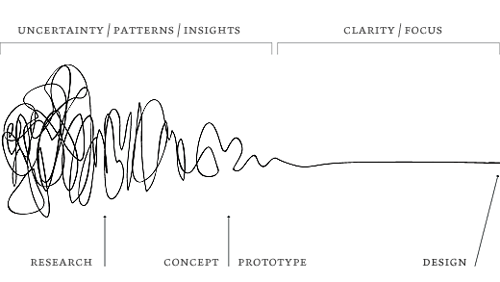
Design Thinking
Ok, so this will be one post of many—Design Thinking is all the rage. My interest lies mainly in the longer term study of the cognitive processes of designers and how these are applied to design problems, after all, the term goes back at least as far as the 1987 study Design Thinking by Peter Rowe. The ideas behind this study go back further to Donald Schön's Reflective Practitioner (1983) and research into the structure of problems in the study of artificial intelligence in the 60's and 70's (Simon Herbert and others).
Nigel Cross sums up the distinction between different approaches to the idea 'design thinking' in "Designerly Ways of Knowing: Design Discipline versus Design Science" by defining different states of the relationship between science and design. The first is scientific design, which alludes to fields of design which have distinct scientific underpinnings such as material science. The second is design science, which is more of an imposition of scientific discipline (ie the scientific method) on the process of design. As such this describes a systematic method of design which tends to produce a very rigid and insufficient response to design problems. The final relationship can be called the science of design, and this one points to design thinking.
Labels:
design,
design thinking
Location:
Gainesville, VA, USA
10/21/2011
Urbanized
I'm working on a whopper for this afternoon so this morning I thought I'd share news of a new film by Gary Hustwit (Helvetica, Objectified).
Urbanized is a feature-length documentary about the design of cities, which looks at the issues and strategies behind urban design and features some of the world’s foremost architects, planners, policymakers, builders, and thinkers. Over half the world’s population now lives in an urban area, and 75% will call a city home by 2050. But while some cities are experiencing explosive growth, others are shrinking. The challenges of balancing housing, mobility, public space, civic engagement, economic development, and environmental policy are fast becoming universal concerns. Yet much of the dialogue on these issues is disconnected from the public domain.
Who is allowed to shape our cities, and how do they do it? Unlike many other fields of design, cities aren’t created by any one specialist or expert. There are many contributors to urban change, including ordinary citizens who can have a great impact improving the cities in which they live. By exploring a diverse range of urban design projects around the world, Urbanized frames a global discussion on the future of cities.
There are still screenings being added, so get on it!
From Urbanizedfilm.com:
Who is allowed to shape our cities, and how do they do it? Unlike many other fields of design, cities aren’t created by any one specialist or expert. There are many contributors to urban change, including ordinary citizens who can have a great impact improving the cities in which they live. By exploring a diverse range of urban design projects around the world, Urbanized frames a global discussion on the future of cities.
There are still screenings being added, so get on it!
Location:
Gainesville, VA, USA
Subscribe to:
Comments (Atom)